Living / Research-based guide
Travel Laundry Bag: Choose for Dry Clothes, Wet Items and Easy Unpacking
By Asian Beauty Finder · Updated November 20, 2026 · Research-based editorial
In this guide
A travel laundry bag works best when it matches the job: separating dry, worn clothes, carrying damp items temporarily, or helping you wash clothes during the trip. Those are different tasks. Start with the clothes you expect to carry and your next opportunity to do laundry, then check the bag’s closure, usable size and care instructions.
You may already own something suitable. A dedicated shopping purchase is useful only if it solves a problem your current packing setup cannot handle. This research-based guide offers a way to make that decision; it is not a hands-on product test or a ranking of the “best” bags.
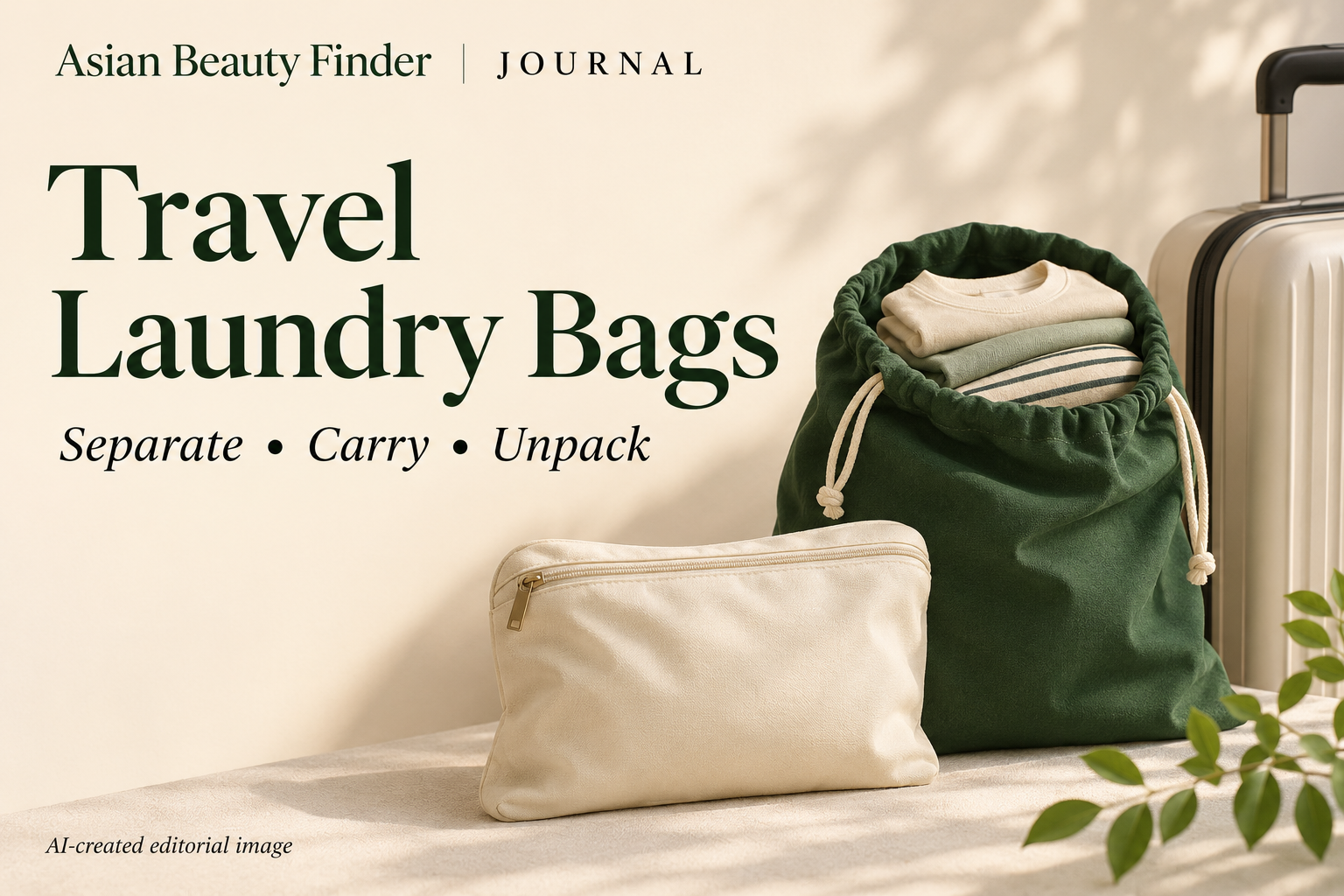
Checked November 20, 2026. Product examples in the sources explain different functions. This article contains no affiliate links. The accompanying image is an AI-created editorial image showing imagined, unbranded items.
Decide what the bag has to do
Choose the function before choosing the fabric or the color. “Laundry bag” can describe a simple sack for worn clothing, a pouch intended for damp items, a mesh bag used during machine washing, or a container designed for hand washing. A label shared by all four does not make them interchangeable.
| Your main task | What to look for | What to check separately |
|---|---|---|
| Separate dry, worn clothes inside luggage | A bag that fits your load and closes without forcing it | Whether you can clean the bag as instructed |
| Transport a damp swimsuit or similar item | Explicit manufacturer instructions permitting wet-item storage | Closure and seam limitations, and when you will unpack |
| Wash clothes inside the bag | A product designed for that washing method | Load limits, detergent guidance, rinsing and drying arrangements |
The distinction is visible in manufacturer information. EzPacking’s travel laundry pouch is explicitly described as unsuitable for holding wet clothes. The Scrubba Wash Bag, meanwhile, includes an internal washboard for washing. These examples establish different intended uses; they are not recommendations to buy either product.
Write your main task in one sentence before browsing. “Carry two days of dry clothes to the hotel laundry room” gives you a clearer starting point than “find a versatile bag.” If you have two different tasks, decide whether separate containers would be easier to manage.
Size it around your next laundry stop
Size the bag for the clothing you will accumulate before the next realistic wash, rather than for the entire length of the trip. A week away with laundry available midway may require a different setup from a shorter trip with no washing opportunity.
Build a sample load at home using the kinds of garments you actually pack. Include the bulky item that could change the result: a sweatshirt, workout clothes or an extra towel. The sample is a planning exercise, not a promise that a particular number of outfits will fit for every traveler.
- Put the sample clothing into the bag without compressing it aggressively.
- Close the bag normally. Leave enough room to operate its opening as instructed.
- Place it in the suitcase alongside the items that will still be there on the return journey.
- Check whether you can remove it without unpacking everything else.
Measure the filled shape as well as the empty dimensions. A flat sack can become awkwardly rounded when full, while a rectangular pouch may fit a specific gap more predictably. If you must push hard to close either the laundry bag or the suitcase, change the load, the arrangement or the laundry plan. A larger bag alone does not create more luggage space.
Check the opening and how you will carry it
The most useful closure is one you can operate with your normal load inside. A drawstring sack may be straightforward to fill, while a wide zip opening may make individual items easier to remove. A roll closure has its own operating instructions and needs room to close correctly.
Think through where the bag will be used. Will it stay flat in a suitcase, hang in a hotel room, or travel down several flights of stairs to a laundry room? For example, Matador describes both top and front zip access on its Packable Laundry Bag. That illustrates why access direction can matter; it does not prove that you need that model.
For a bag you own, look for obvious damage around the opening, handles and seams. Operate the closure gently with the sample load inside. Stop if the fabric is caught or the fastening needs force. This is a usability check, not a durability or waterproofness test.
For a purchase, examine the handle arrangement and the seller’s intended carrying method. A small hanging loop is not automatically a comfortable carrying strap. If the bag will hang, use a suitable support and follow any stated load limit; do not assume a bathroom fitting is designed to hold a full laundry load.
Give wet items a separate arrival plan
A wet-item pouch is a transport choice, not a replacement for unpacking and following the clothing’s care instructions. Decide where the damp item will go when you reach your destination before putting it in the bag.
Check the manufacturer’s wording carefully. A description of waterproof fabric does not, by itself, explain what happens at the opening or seams. Look for the intended use of the complete bag and any closure instructions. Do not assume an ordinary drawstring opening or zip makes a container suitable for wet items.
Keep damp items separate from your dry laundry unless the complete setup is intended for that combination. Place the pouch where you can retrieve it at arrival, rather than under items you will not unpack until the next day. When you arrive, remove the contents and arrange washing or drying according to their labels and your accommodation’s rules. Avoid inventing a universal number of hours that any damp item can stay packed.
The same planning principle applies to personal-care supplies: something that contains moisture during transit still needs an arrival routine. Our travel soap case guide covers that separate decision for soap.
Read care instructions before you buy
Choose a bag you can realistically maintain during and after the trip. “Laundry bag” does not mean the container itself can go through every washing or drying cycle that its contents can tolerate.
Look for instructions for the exact item, including its lining, coating and fastenings. Check whether care means wiping, spot cleaning, hand washing or machine washing, and whether the manufacturer gives drying restrictions. If the description and care section disagree, ask the seller to clarify before relying on either method.
Keep a copy of useful instructions with your packing notes. A care label that remains attached is easier to consult later than a remembered product description. Avoid adding bleach, disinfectant or another cleaning product simply because you associate it with laundry; use only methods allowed for that bag.
Also think about the destination. A bag that needs a particular cleaning and drying routine may be inconvenient when you are moving hotels each morning. That does not make the bag poor quality. It means its maintenance needs may not fit this trip. A simpler container you can care for properly can be the more practical choice.
Rehearse the trip with what you already own
Try one complete packing cycle before buying another organizer. Choose an existing bag that is clean, in suitable condition and appropriate for the intended contents. Do not turn a dry-clothing container into a wet-item bag by assumption.
At departure, give the empty laundry bag a specific location. Make it easy to find once you start changing clothes. Keep toiletries in their own suitable containment, rather than using clothing as padding around bottles that might spill. Our travel care kit guide helps you decide which personal-care items need space in the first place.
At the accommodation, choose a consistent place for worn clothes. If you are sharing luggage or a room, distinguish bags by a label, color or agreed position. Keep a wet-item pouch accessible so it is not mistaken for a bag of dry laundry.
Before moving on, check the next laundry opportunity and the space available in your luggage. At home, unpack the contents, follow the clothing and bag care instructions separately, and let the cleaned bag dry as directed before storing it. The aim is a repeatable routine. If the rehearsal works, there may be no useful reason to replace the bag you have.
A quick decision before checkout
A purchase is easier to assess when you know which requirement is missing. Perhaps your current bag is too large when filled, has no convenient carrying method, or is not intended for the damp items you need to transport. Use that specific problem to compare alternatives.
- Fit: compare the usable dimensions with your sample load and available luggage space.
- Function: confirm whether the bag is for dry storage, wet-item transport or a defined washing method.
- Handling: check the opening, carrying arrangement and any closure or load instructions.
- Care: make sure the required cleaning and drying routine is feasible.
- Purchase terms: check current availability, delivery to your address, the delivered price and return conditions with the seller.
Save the specific model and size you compared. Similar-looking variants may have different details. If the seller cannot explain a feature you need, leave that point unresolved rather than filling the gap with a review of a different version. You can keep using a suitable existing bag while you decide.
Common questions
Can a packing cube serve as a travel laundry bag?
It can be a practical container for dry, worn clothing if its size, condition and care instructions suit the task. Keep its role clear so it is not confused with a clean-clothing cube. Wet storage and washing compatibility need separate confirmation.
Will a compression bag solve a full suitcase?
Check your actual packed load. A compressible container may change the shape or bulk of suitable contents, but it does not reduce their weight or guarantee that the suitcase will close. Leave enough room to use the fastening properly.
Can I wash clothes inside any laundry bag?
No. A storage sack, a mesh washing bag and a wash-in-bag device have different purposes. Follow the instructions for the exact bag, the garments and the washing equipment. Buying a storage bag does not establish that it is safe or effective for washing clothes inside it.
Start with your next laundry stop, make a realistic sample load, and check the bag you already own. Those three steps will tell you more about what you need than a long list of extra compartments.